29 December 2025
Cash ISA vs Stocks and Shares ISA: Which is right for me?
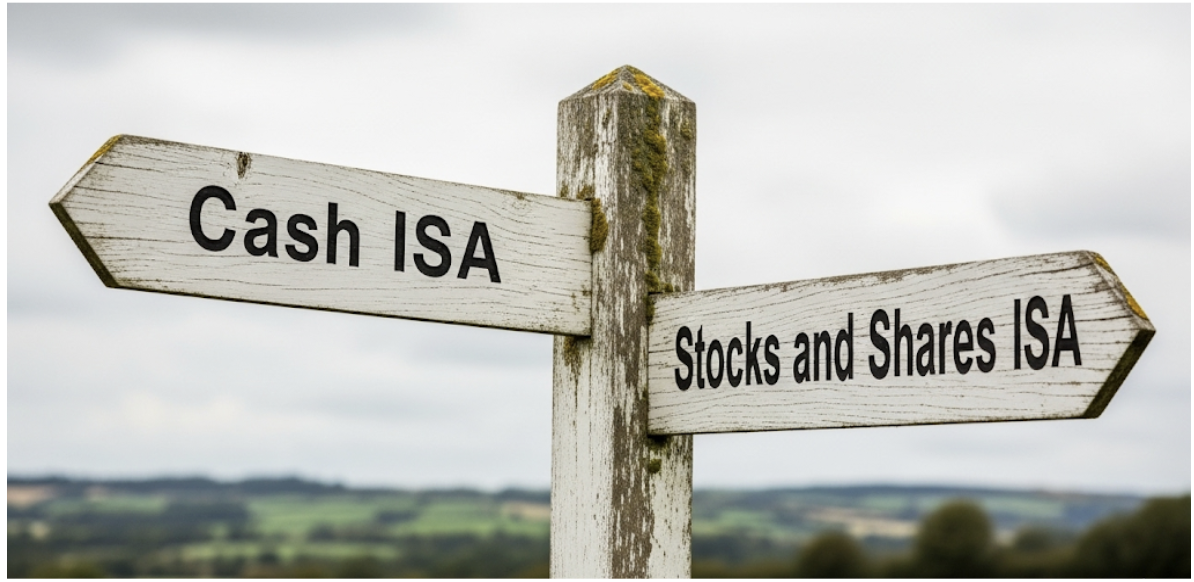
Choosing the best savings strategy for your needs can be a tricky process. There are so many different types of savings accounts, savings plans, and investments available that it can be challenging to know which is right for you.
One common question is about ISAs, and which type of ISA is best for your investment strategy.
Over the course of this article, we will be exploring some common questions when it comes to choosing between a Cash ISA and a Stocks and Shares ISA.
Cash ISAs vs Stocks and Shares: What’s The Difference?
The key difference between a Cash ISA and a Stocks and Shares ISA is how your money is invested.
A Cash ISA is similar to a traditional savings account, where you save money and your bank or ISA provider pays you a fixed rate of interest.
With a Stocks and Shares ISA, your provider will invest your money on your behalf, hoping to capture more money from their investments than you would receive in interest.
When Would I Open a Cash ISA Vs Stocks and Shares ISA?
Although they are similar types of investment, the difference in how your money is held has a significant impact on how these ISAs are commonly used.
A Cash ISA typically offers greater stability and is less likely to lose value. However, because the rate of interest on your investment is fixed, this means that there is a limit to how much you can earn.
A Stocks and Shares ISA is more volatile. Although it is less stable than a Cash ISA, there is a chance to earn a greater amount of money over time.
Due to the increased stability, Cash ISAs could be used as a way to invest your money while you develop an investment strategy, if you receive a windfall, or if you are approaching retirement and want more stability.
However, because Stocks and Shares ISAs can capture a greater amount of value, these may be more effective as a long-term investment vehicle. Although the value may decrease in the short term, if invested for a sufficiently long period, it is also likely to recover and even increase in value, with the aim of earning more money than the interest you would earn with a Cash ISA.
In simple terms, a Cash ISA may be the best option when looking for stability or when you might need immediate access to your money, but a Stocks and Shares ISA may be better suited for long-term investments, as it creates the opportunity to earn more money overall. As well as offering greater potential gains, our Stocks and Shares ISA has smoothing, a process where Sheffield Mutual will hold back some profits during good years and use the money to ‘smooth’ our ISA products, providing additional stability even during negative market conditions.
How Many ISAs Can I Have?
Currently, there is no limit on the amount of Cash ISAs or Stocks and Shares ISAs you can open with different providers (except for the Lifetime ISA). Instead, the UK Government will set an annual limit that determines how much money can be saved in ISAs for that tax year. As long as the total amount you contribute to all your ISAs in a year stays below the current limit of £20,000, you can choose a variety of ISAs to suit your needs.
However, this rule does not apply to Lifetime ISAs (LISAs). Due to the unique benefit of a LISA, where the UK Government will add 25% value to your savings up to an annual limit of £4,000, customers are strictly limited to opening only one Lifetime ISA.
Should I Choose A Cash ISA or a Stocks and Shares ISA for My Child?
Choosing an investment strategy to help your child is a significantly individualised process, so you should always browse a wide range of products and strategies before committing to any decision.
However, when it comes to Junior ISAs, there are a few factors to consider.
First, a child can only have one Stocks and Shares ISA and one Cash ISA, whereas adults can open multiple ISAs of either type.
The second point to consider is that the annual allowance for Junior ISAs is much lower, currently £9,000.
Finally, it is crucial to consider your child’s age. If you are opening an ISA for your child, they will not be able to remove the cash from that ISA until they are 18 years old. This means that there is a much more defined timeline involved in their financial planning.
When considering all of these factors, it seems likely that a Junior Stocks and Shares ISA, like Sheffield Mutual’s Investment Junior ISA or Sustainable Junior ISA, may capture more profit over time. However, like with the adult ISA, a Junior Stocks and Shares ISA has a higher risk than a Cash ISA.
If you would like more information about Sheffield Mutual’s Investment Junior ISA, please read this important information document. If you are interested in our Sustainable Junior ISA, please read our Sustainable Junior ISA important information document for more details.
Please note: Capital is at risk. Tax treatment depends on individual circumstances and may be subject to change in the future. Please read all product information carefully before committing to an investment strategy.
Find The Right ISA For You At Sheffield Mutual
At Sheffield Mutual, we’re committed to helping our members find the right financial products to meet their needs.
Our range of ISA products includes the Regular Premium Investment ISA, the Single Premium Investment ISA, the Regular Premium Sustainable ISA, and the Single Premium Sustainable ISA, as well as the Investment Junior ISA and our Sustainable Junior Investment ISA.
Please note that all ISA products offered by Sheffield Mutual are Stocks and Shares ISAs. You will need to read the product information carefully before committing to a strategy.
If you are interested in any of our ISA products or would like to become a member of Sheffield Mutual, please contact us via email at enquiries@sheffieldmutual.com or by calling 01226 741 000. Our friendly and helpful team will be happy to assist you.
This blog provides generic information and the writer's opinions and should not be relied upon for investment decisions. Sheffield Mutual has provided no advice. If you doubt whether a savings or investment plan suits you, consider contacting a financial adviser for advice. If you do not have a financial adviser, you can get details of local financial advisers by visiting www.unbiased.co.uk or www.vouchedfor.co.uk. Advisers may charge for providing such advice and should confirm any costs beforehand.